
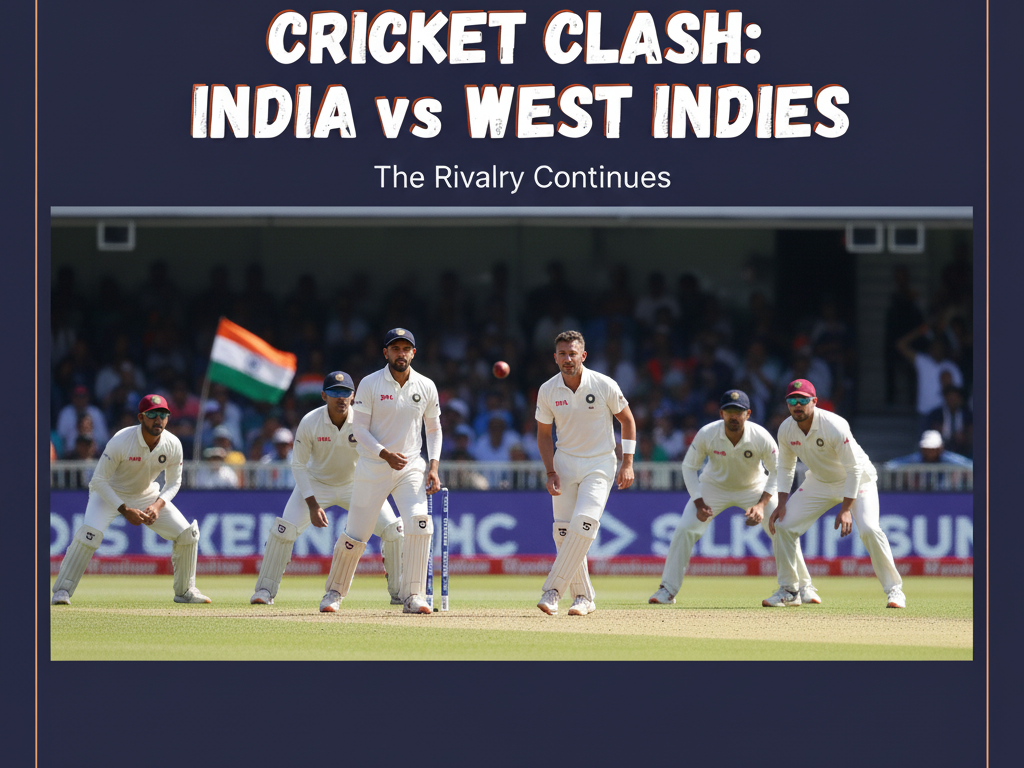
India vs West Indies — Match Update today
After a comprehensive win in the first Test by an innings and 140 runs, India entered the second Test in Delhi with confidence and momentum. That first match saw big centuries — KL Rahul, Dhruv Jurel, and Ravindra Jadeja — and disciplined bowling that dismantled the West Indies batting lineup in both innings.
Now, playing at the Arun Jaitley Stadium (formerly known colloquially as “Kotla”) in Delhi, India aimed to wrap up the series with another dominant display. The pitch was expected to offer some assistance to batters early on, with possible spin influence later in the game.
Toss & Team Combinations
One interesting prelude to the match: Shubman Gill, newly appointed Test captain, finally won a toss in Test cricket, having lost the previous six tosses he contested. He chose to bat first — a logical move to put runs on the board on a batting-friendly Day 1 surface.
India retained the same playing XI that had performed so convincingly in Ahmedabad. West Indies, on the other hand, made two changes: Anderson Phillip and Tevin Imlach came in, replacing Brandon King and Johann Layne.
By choosing to bat, India signalled their intention to dominate the first innings, possibly putting the West Indies under pressure from the outset.
Day 1 Unfolds: India’s Stronghold
Morning Session — Steady Opening
India started with Yashasvi Jaiswal and KL Rahul at the crease. The early overs saw cautious progress, as the West Indies bowlers looked to probe for any movement or seam.
By lunch, India were 94/1, with Jaiswal unbeaten on 40 and Sai Sudharsan on 16. The openers had laid a solid platform, albeit with the occasional verbal battle between batters and bowlers.
Middle Session — Jaiswal Takes Over
Post-lunch, India shifted gears. Yashasvi Jaiswal accelerated, finding gaps on both sides of the wicket, and putting pressure on the bowlers. His strokeplay was a mixture of authority and control.
The first wicket fell when Jomel Warrican trapped KL Rahul (stumped). Rahul had made 38 off 54 (5 fours, 1 six) before his fight was ended.
Soon after that, Sai Sudharsan, who had been putting in a useful fight, was dismissed lbw by the same Warrican for 87. That ended a big 193-run partnership between him and Jaiswal.
At that point, India stood at approximately 251/2 in 68.3 overs.
Final Session — Jaiswal’s Masterclass
The last session of the day belonged definitively to Jaiswal. He continued to bat with temperament, weaving his way among spins and pace, rarely surrendering control.
By stumps, India were 318/2 in 90 overs — a commanding position. Jaiswal was unbeaten on 173 off 253 balls, while Shubman Gill remained at the crease with 20 (off 68 balls).
Notably:
- India added 98 runs in the final session, losing just one wicket (Sudharsan).
- Jomel Warrican was the only bowler to get both wickets, finishing with figures of ~2/60 in around 20 overs.
Thus, India ended Day 1 in dominant fashion — minimal damage, maximum control.
Milestones & Key Performances
Yashasvi Jaiswal — Statement Knock
- Jaiswal’s 173* is a signature innings, and it is being lauded widely as one of the defining knocks of the match so far.
- With this century, he moved to seven Test hundreds, joining an elite club alongside legends like Sachin Tendulkar.
- The knock showed maturity — mixing aggression with caution, picking the right moments to attack and consolidating where needed.
Sai Sudharsan — Valuable Contribution
Though he got out, Sudharsan’s 87 was a key effort, enabling India to build a strong second-wicket foundation. His innings provided breathing room for Jaiswal to shift gears.
KL Rahul — Brief but Useful
Rahul’s 38 was solid but short of a big score. His wicket by Warrican arrived at a point India could afford it.
Bowling & Fielding — West Indies’ Struggles
- Jomel Warrican was the lone bright spot, getting the two Indian wickets and showing control, especially against the top order.
- The rest of the bowling attack was badly lacked consistency and penetration. India often relieved pressure by punishing errant deliveries.
- Fielding lapses, especially spilled chances (e.g. early in Sudharsan’s innings), compounded West Indies’ woes.
What This Means for the Match & Series
India Is in Command
Ending Day 1 with 318/2 and a rolling machine like Jaiswal at the crease, India have done exactly what one would expect of a dominant side. The plan to bat long, sap confidence from the opposition, and keep momentum is well on track.
From here:
- India can aim for a large first-innings total, putting pressure on the West Indies to respond with grit.
- They can smartly manage the rest of Day 2 to keep wickets in hand and gradually apply the squeeze.
- Using their spin reserves later, they could exploit wearing pitch conditions and force collapses.
West Indies Facing an Uphill Task
For the visitors:
- They must find early breakthroughs on Day 2 to derail India’s innings before it becomes runaway.
- Their bowlers need better execution — disciplined lines, tighter field setting, sharper variation.
- Bold strategies might be needed — mix spin and pace cleverly, rotate bowlers, and pressure the lower middle order.
- Their batting, so far fragile, would need to carry more responsibility in subsequent innings.
Tactical Questions to Watch
- When will India declare? How deep will they bat?
- Will West Indies take the new ball early to use pace, or rely on spin as conditions evolve?
- Which of India’s middle-order batters (Jadeja, Jurel, Sundar) will contribute materially?
- Can the West Indies find a plan to counter Jaiswal’s dominance (e.g. smart fielding, bowling changes, attacking lines)?
Previewing the Road Ahead
Given how Day 1 panned out, India appear to be well-positioned to wrap up the series. The real challenge is converting this dominance into concrete advantage — extending their lead, wrapping up the first innings, and then applying pressure with the ball.
For West Indies, this match is now a battle for pride and salvage. If they can claw their way back into the game, especially through disciplined bowling and gritty batting in subsequent innings, there’s still scope for fightback. But the margin for error is thin.
If India sustain their aggression and clarity of plans, this Test—and hence the series—could be settled early. Yet cricket allows for surprises, and West Indies must believe they have tools to make things interesting.